

On a construction site, decisions are made every day. How far along is the frame? Are there enough workers on the floor? Are conditions right for tiling? Too often the answer is found only when someone walks over to look, calls the site supervisor or digs the information out of three different systems.
Construction site situational awareness means this information is available to everyone in one place, up to date and verified. It improves communication, documents the construction process and does something many have not yet noticed: it lays the foundation for using AI effectively. Once site data is in one place, AI can take over tasks that used to require manual work from site management.
This article explains what situational awareness is, what it brings to a project and how AI builds on top of it.
What is construction site situational awareness?
Situational awareness is a shared, up to date view of what is happening on site. It is not one report or one camera but a whole built from several sources:
- 360 images show what every space looked like on a given day. You record them by walking the site with a 360 camera.
- Site cameras show what is happening right now and compile time lapse sequences of progress.
- Condition monitoring tracks temperature and humidity, for example, which affect drying and the quality of structures.
- Workforce analytics shows how workers are distributed across areas of the site and over time.
- Drone data gives an overview of large areas and exterior works.
Each source is valuable on its own. The real benefit comes when they are in the same view and on the same timeline. Then the project manager, supervisor and developer see the same reality without anyone having to compile it by hand.
Situational awareness improves communication
A construction project always has many parties: main contractor, subcontractors, designers, supervisor, developer and finally the end user. Each has their own idea of the situation, and much meeting time goes into working out what the situation actually is.
Shared situational awareness changes the conversation. When everyone sees the same 360 image or camera view, there is no need to argue whether an installation has been done. You simply open the image. An observation can be marked directly on the image and assigned to the person responsible, so the information does not get lost in an email thread or on a sticky note.
Communication also improves beyond the site. Developers and supervisors can follow progress remotely and focus site visits on the moments when being there matters most.
Situational awareness documents the construction process
Much of construction ends up hidden: pipes, wiring, insulation and fixings are covered by the next work phase. Without an image, nobody can later verify how they were done.
Regular 360 recording captures every space at every stage. When a question comes up later, for example during a claim, maintenance or alteration work, the answer can be found in the images by date and location. The same applies to conditions: the measurement history shows that structures were allowed to dry in the right conditions.
Documentation becomes a by product of the work, not a separate task. And this comprehensive, time stamped material is exactly what AI needs.
Without situational awareness, AI has nothing to read
There is a lot of talk about AI in construction, but one thing is often forgotten: AI is only as good as the data it can access. If site information is scattered across notes, phone calls and different systems, AI cannot say anything reliable about the site.
Situational awareness solves this. When 360 images, camera footage, condition data, workforce data and the schedule are in one place and on one timeline, AI can compare them. It can ask: does the actual situation on site match the plan? If not, where and why?
From manual tasks to automation
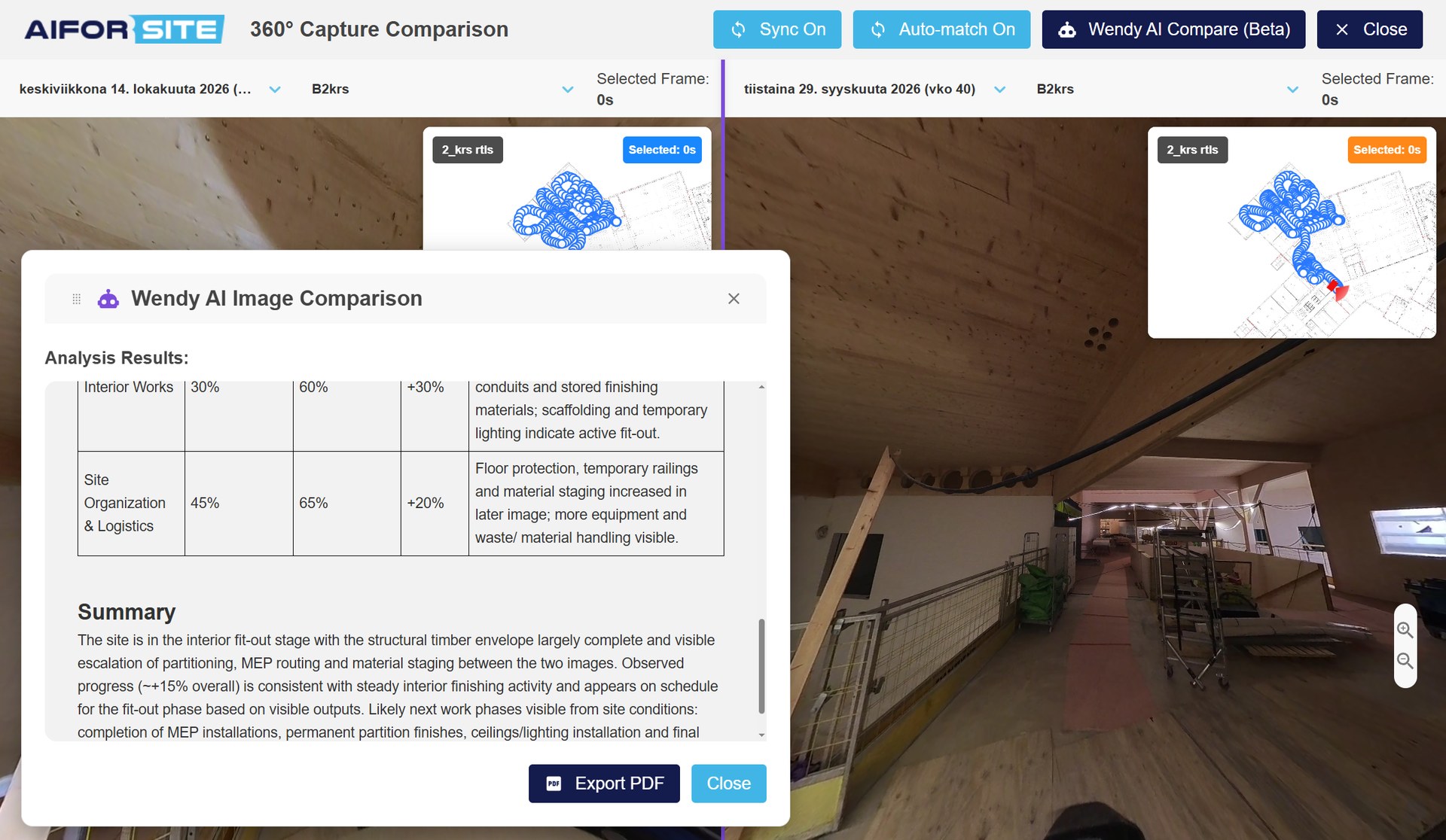
Many site management routines are exactly this kind of comparison. They have been done by hand because there was no other way. Aiforsite’s Wendy AI assistant already handles tasks such as these automatically:
- Daily email briefing. Wendy compiles the site status and sends it to site management at a chosen time, for example every morning.
- Schedule vs 360 comparison. Wendy compares scheduled tasks with the latest 360 captures and reports, area by area, which tasks are on track, ahead or behind.
- Planned vs actual resources. Wendy compares planned crews with Workforce Analytics data and alerts site management when the number of workers on site differs from the plan.
- Work permit check and risk briefing. Wendy checks the day’s work permits against who is on site and lists companies working without a permit. It also compiles the risks of the day’s permitted tasks, such as electrical work or work at height.
You can also ask Wendy about the site in plain language, in English, Finnish or other languages, and the answer is based on the site’s own data.
The key point is that AI does not replace site management. It frees site management from compiling and checking information so they can focus on what needs a human: decisions, leading people and solving problems.
How to get started
You do not need to build situational awareness all at once. Most start with one site and one module, typically 360 recording, and add cameras, condition monitoring and workforce analytics as needed.
- Choose a site and a goal. What is the biggest pain point: communication, documentation or schedule tracking?
- Start regular 360 recording. Recording is done with an Insta360 camera and its own app, and the material is uploaded to the Aiforsite web app. No separate app needs to be installed.
- Add data sources. Cameras, condition monitoring and workforce analytics complete the picture.
- Turn on Wendy AI. Once the data is in place, automations and questions start delivering value right away.
Aiforsite has been used in more than 400 construction projects, and SRV’s Nissniku site, where Aiforsite was in use, was named Construction Site of the Year 2026.
Frequently asked questions
What is the difference between situational awareness and a site report?
A report is a snapshot that someone writes. Situational awareness is a continuously updated view based on images, measurements and other verified data.
Do I need special skills to use AI?
No. You ask Wendy AI questions in plain language, and the automations run on a schedule without separate effort.
Can situational awareness be built in stages?
Yes. Typically you start with 360 recording and add other modules as needed.
Does AI replace site management?
No. AI handles compiling and comparing information, and site management uses the time saved for decisions and leading people.
Summary
Construction site situational awareness improves communication because everyone sees the same reality. It documents the construction process as a by product of the work. Above all, it lays the foundation for AI: without comprehensive site data, AI cannot automate anything reliably.
Want to see what situational awareness would look like on your site? Book a demo.